

A Practical Path from Exploration to Applied Learning
Artificial intelligence is no longer a future issue for education and training organizations. Students are already using it, employers are beginning to expect familiarity with it, and federal policy is increasingly rewarding institutions who can demonstrate progress in AI literacy, educator readiness, and workforce development.
Stanford’s 2026 AI Index reports that four out of five U.S. high school and college students now use AI for schoolwork, even as government and institutional policies remain uneven. At the same time, the U.S. Department of Education has finalized grant rules that explicitly give additional weight to projects that expand the understanding of artificial intelligence, support appropriate and ethical AI use, strengthen educator preparation, and create AI-related learning and credential pathways. The National Science Foundation and the U.S. Department of Labor are coordinating around AI literacy, upskilling, and reskilling as part of their national workforce priorities. These signals matter because they create stronger justification for institutions who want to align AI efforts to educational quality, grant opportunity, and workforce relevance rather than to stand-alone technology acquisition.
The argument here isn’t that educational institutions should rush into large-scale AI adoption; artificial intelligence, after all, raises legitimate questions about data privacy, bias, student safety, academic integrity, and long-term fit with institutional missions. Public research on early adopters shows that most organizations are still experimenting with pilot programs and are struggling to separate meaningful progress from vendor hype. In K–12, for example, the Center on Reinventing Public Education (CRPE) found that roughly 80% of the early-adopter districts it studied were still in the earliest phases of experimentation, with fragmented pilots and limited system-wide implementation. Microsoft’s 2026 congressional testimony on AI in education noted that teachers are asking for stronger AI literacy, clearer guardrails, and classroom-ready tools that support human judgment rather than replace it.
The challenge, then, is not whether to move quickly or slowly—it’s how to move deliberately.
For many institutions, the best next step is implementing a structured process that clarifies educational goals, workforce objectives, governance requirements, and practical starting points. The AI use cases that appear to be gaining the most traction are not the most futuristic ones. They are practical applications that help institutions reach students more effectively, support overburdened educators, improve persistence in high-friction moments, and give learners applied experience with tools they are likely to encounter in the workplace. The common thread in AI success stories is that the environment follows the strategy, not the other way around. Sterling’s view is that institutions need a practical way to move from curiosity and caution to governed, useful, and scalable capabilities.
What Leading Institutions Are Already Doing
The strongest argument for thoughtful AI adoption is what institutions are already accomplishing in bounded, measurable ways. Georgia State University offers one of the clearest examples. Its AI-supported student messaging system helped reduce “summer melt” — the loss of admitted students between acceptance and fall enrollment — from 19% to 9% by giving students timely reminders and answering questions about registration, deadlines, and financial aid. Georgia State has also extended AI-supported, chat-based assistance into gateway courses.
Public reporting from Complete College Georgia shows that in American Government courses, students supported by the chatbot were 8% more likely to earn a B or higher, 16% more likely to earn an A, and 16% less likely to withdraw than the control group. Pell-eligible students in the treatment group were 20% less likely to receive a D, F, or withdrawal. In Macroeconomics, first-generation students supported by the chatbot were 23% more likely to earn a B or higher and 38% less likely to drop the course.
In K–12, the first benefits to emerge have been teacher productivity and targeted instructional support. The same 2025 CRPE study of AI early adopters found that districts are most often using AI to reduce routine teacher workload, support lesson planning, generate differentiated materials, and assist with communication. The paper cites a 2025 Gallup finding that states that teachers using AI at least weekly reported saving an average of six hours per week. Many of these early adopters have not solved the harder questions around pedagogy or student safety, but their districts are finding value in low-risk, educator-centered starting points, a repeatable pattern for any institution considering how to begin.
There is also emerging evidence that AI-enabled learning tools can improve student outcomes when they are used consistently within a structured instructional model. For example, Khan Academy reports that students who engage deeply with its platform over the course of a school year—demonstrating mastery across a broad set of concepts—tend to make meaningfully greater academic progress than expected for their grade level. In school-based deployments, these outcomes are more pronounced when the tools account for a student’s learning history, and when usage is guided by educators and embedded into coursework, rather than left to independent use. Khan Academy’s conclusions reinforce a broader lesson for institutions: The impact of AI in education is driven less by access to tools and more by how those tools are integrated into teaching, practice, and feedback.
Community colleges are emerging as especially important in national AI literacy policy because they sit at the intersection of education, workforce training, and economic mobility. Achieving the Dream’s 2025 report “Creating the AI-Enabled Community College” cites survey evidence showing that 66% of business leaders would not hire someone without AI skills, while 71% would prefer a less-experienced candidate with AI skills over a more-experienced candidate without them. MIT and Georgia State’s new PATH initiative is building industry-aligned AI training pathways across universities and community colleges, with more than 1,000 Georgia State students already enrolled in early PATH courses.
From Scattered Experimentation to Institutional Capability
These AI adoption initiatives reveal similar use case categories: institution and classroom administration, research support, and student learning. The organizations finding the most success are treating AI as an institution-wide capability tied to student achievement, faculty development, operational improvement, and labor-market alignment. Even so, many other organizations remain hesitant, with IT and academic leadership still trying to understand risk, oversight, and long-term direction. In workforce development settings, providers may agree that learners need some level of AI familiarity but remain unsure how to integrate the technology into programs without overbuilding too early.
This tension underscores why an institutional response must begin with strategy rather than procurement. Organizations are trying to determine which of their educational and workforce objectives matter most, what use cases are worth pursuing, what safety and governance requirements apply, and what scope or size of technical environment is needed to support all of these priorities. Without that front-end work, institutions risk being pulled in two unhelpful directions: broad caution that prevents useful progress, or premature infrastructure investment that is difficult to justify and harder to sustain.
The Benefits of an AI Student Lab or Applied AI Learning Environment
Today, many AI tools are available for free or via low-cost subscription, so why would an institution purchase and maintain its own infrastructure? A well-designed AI student lab is not simply a room full of hardware. It is a controlled environment in which institutions can teach AI literacy, support faculty experimentation, enable applied learning, run student projects, test tools, and expand responsibly over time. Labs are a way for institutions to maintain their staff and students’ data and model sovereignty. For some customers, their own technical environment could begin with smaller form factor, AI-capable endpoints and foundational software. For others, it may evolve into a shared applied lab that supports retrieval-augmented generation, multimodal work, automation, or workforce simulations. For more advanced programs, it may eventually support interdisciplinary innovation or research. Not every institution has the same needs. A lab can provide a practical framework for moving from scattered experimentation to governed capability.
A Practical Path Forward
Sterling recommends that institutions approach AI readiness in three distinct stages:
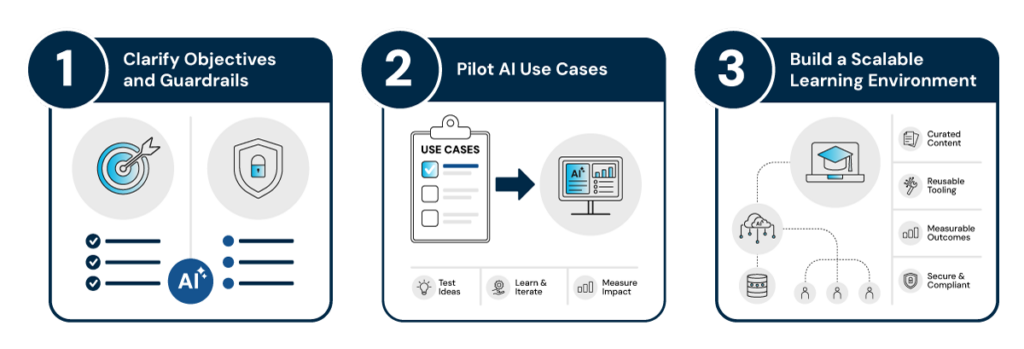
The first is to clarify objectives and guardrails. Before deciding what environment to build, institutions need to define the academic, workforce, and operational outcomes they care about most. They also need to establish the conditions under which AI will be used responsibly, including governance, oversight, and privacy expectations. Sterling’s advisory and workshop model is designed to help organizations do that work up front so that decisions are tied to real institutional priorities rather than to generic market enthusiasm.
The second is to pilot AI use cases. Once priorities are clear, institutions can test AI in a manageable way through a defined learner population, a limited set of faculty, a targeted workforce use case, or an initial software and endpoint environment. The goal at this stage is evidence, not scale. What use cases create value? Where is the friction? This phase gives leadership a credible basis for deciding what to stop or what to expand, as well as what kind of technical environment is justified.
The third is to build a scalable learning environment. Only after evidence from experimentation is collected should institutions commit to building an applied learning environment. Software, services, endpoints, and shared infrastructure can be aligned with demonstrated needs rather than assumptions. Sterling’s role here is to help scope the right mix of technologies and services, implement them in a way that fits the institution, and support adoption over time. As a vendor-agnostic partner, Sterling adheres to the customer’s objectives rather than to a single solution or product agenda.
Why Sterling for AI
The organizations most likely to benefit from AI in the years ahead will be those that define clear objectives, build confidence through measured action, and scale with purpose. Sterling’s structured approach to AI readiness gives institutions a way to do exactly that. We are here to help educational and workforce-training organizations evaluate where AI makes sense, where caution is warranted, and what kind of environment is appropriate for achieving their goals.
Use our contact form below to connect with one of our AI experts and gain a better understanding of the AI outcomes that are available to you. Or, for a more informal perusal, explore our Artificial Intelligence page to gain insights into how Sterling can support you through your unique AI use case.
Article Author

Andrew Peppler’s background includes roles as a Senior Strategy and Policy Analyst for the DoD’s Chief Digital and Artificial Intelligence Office (CDAO). At CDAO, he spearheaded an effort to draft and coordinate the new DoD AI Strategy, unifying the department’s digital and AI vision. He identified cultural, rather than technical, issues as the main impediment to AI adoption, advocating for human-centered solutions and process reform. Now at Sterling, he leverages this strategic expertise to drive AI innovation, working closer to implementation.